
– First question: how long have you been growing your hair and how do you take care of it?
– Oh, I like questions like that 🙂 Otherwise, it’s all about cassettes and synthesizers! I’ve been growing it for over 20 years! But a couple of times I freaked out and cut it off completely 🙂 I wash it once a week, and I almost never comb it 😁
– I’m sure few people know or remember that the third release of Dronarivm was your album Paleolith, released on cassette in 2012. But then, 13 years ago, you were better known as Creation VI, not Tim Six. Where did this self-name come from, what is the difference between these two hypostases of yours, and how do they coexist today?
– The name came from my parents, because Six is a literal translation of my last name from Ukrainian 😊 At first, everything I did was under the alias Creation VI — both ritualistic near-dark themes, pure drone, and guitar (at that time) ambient. But then the project was finally given a certain ritual-dark aesthetic: “organic” music without synthesizers, made entirely from manipulations with voice and acoustic instruments — as it already was on Paleolith. And then I decided to separate the electronic part and play it under my own name.


– Yes, then, I remember, you lived in Crimea, when it was still with Ukraine. Then you came to Russia. If I’m not mistaken: Yaroslavl, then St. Petersburg. After the war began, you left for France. Tell us how your cultural, psychological, and social adaptation went. Is there anything you miss there, and vice versa, what are the advantages of living in Paris?
– Well, yes, moving, wandering — I’ve had quite a lot of that, and I think there will be more. It’s hard to say about adaptation — with the arrival of children, the focus shifted to home and family, so in principle I rarely communicate with anyone here. First of all, I miss my community, like-minded people from the scene, the opportunity to play concerts. But there are, of course, many advantages, at least in terms of living conditions. At first, in contrast, you realize how withdrawn and irritable people are in Russia — and this is despite the fact that the French consider Parisians to be the same 😁 Naturally, there are problems everywhere, and I don’t know a single perfect country, but in comparison with what is happening now in Ukraine and Russia, it is of course a huge privilege to live a quiet family life here, to have the opportunity to publish music again, to revive my label Global Pattern, and to launch a new label Ш, which recently released its first release.
– Tell us a little about your publishing activities. Your most active label Global Pattern is dedicated to vaporwave music. Is this genre still alive, developing, or fading into oblivion? What releases are you planning for the new label Ш? And do you think about bringing ΠΑΝΘΕΟΝ back to life?
– Vaporwave is certainly not what it used to be =) But it always had that theme, so I can’t say that anything has changed fundamentally — except that some subgenres have already become established, and their own, in many ways separate, communities have formed around them. So the label is alive, although not in such a vigorous rhythm as before.
The new label Ш was originally conceived as a platform for noisier, industrial-sounding projects, but there is no clear plan for it yet. Rather, it is a kind of sandbox for experiments, which I hope to present soon — and then we’ll see!
Well, I tried to restart ΠΑΝΘΕΟΝ last year, but it stalled again due to a banal lack of time. So if I do restore it, it will be purely for digital editions.
In fact, I have thoughts about another label, haha! But I’m in no hurry so as not to spread myself too thin, although I already have an idea of what it will look like. In a nutshell, I want to release something genre-less-strange-collage — music that I’ve been hearing quite often lately, but for which I haven’t yet found a specific name.
– Ok, let’s talk about music and your new Alpine Valley EP. By the way, family life often leaves less time and space for creativity. How are you doing with that? How do you generally approach the process? Where does work on a particular track begin? And specifically, what is the background of your new EP?
– Of course, there is less time — you have to optimize. But there’s also more inspiration — children remind you of all sorts of things from your own childhood, make you change your usual focus of attention. You notice all sorts of pleasant little things, you’re less distracted by media noise… Well, and playing music with children is also quite fun 🙂
Usually, everything starts with some kind of improvisation, with searching for a new shade of sound — then it itself suggests what comes next. Or everything starts with some kind of field recording: I just start playing along with them when I listen to what has accumulated on the recorder — that’s exactly what happened in the case of this EP.
We went to the Mont Blanc area several times, and of course, there is amazing nature: archetypal postcard landscapes, delicious air… Although all this will most likely not last long — the glaciers are melting, many plants and animals are disappearing — so I wanted to capture the atmosphere of these places, even if it was as a kind of impressionism, my own interpretation.
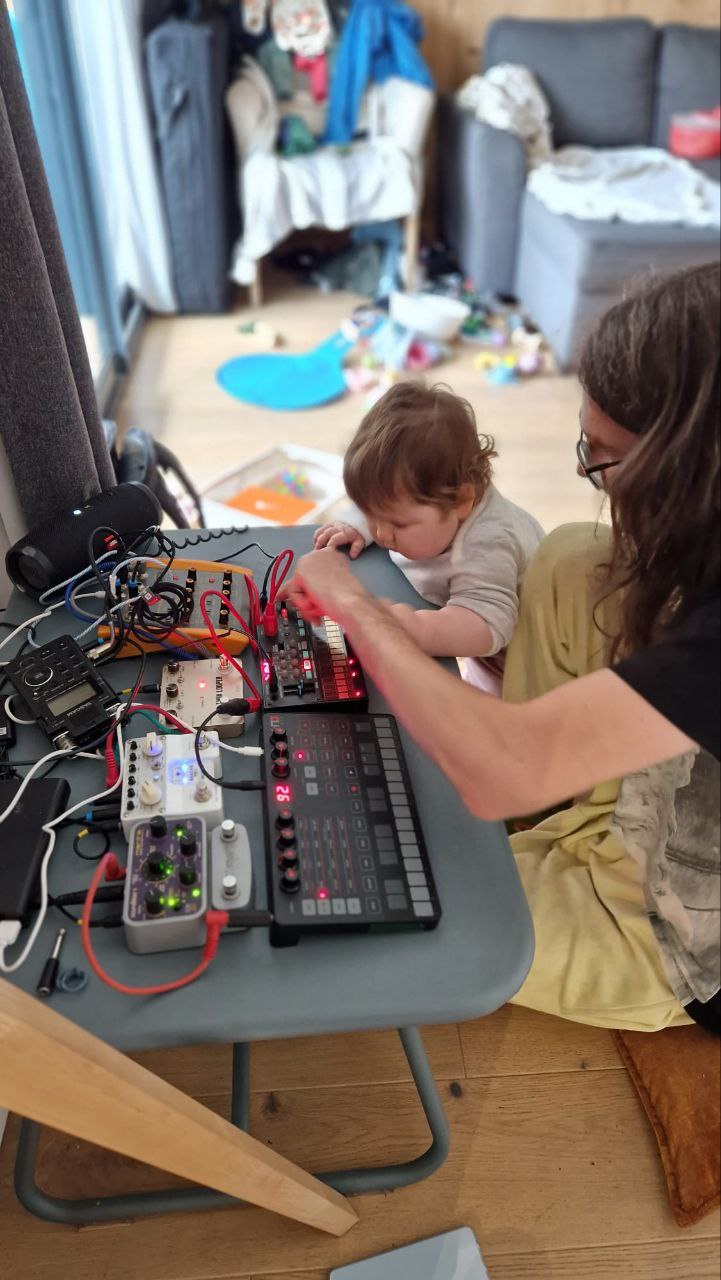
– The credits for this EP list several synthesizers: Korg Wavestate, Korg Volca FM, UNO Synth. Do you generally prefer to play “hardware” instruments, or are you not averse to using computer sound? Do you work with processing field recordings into unrecognizable abstractions (as, for example, Francisco López does), or do you prefer pure natural sound?

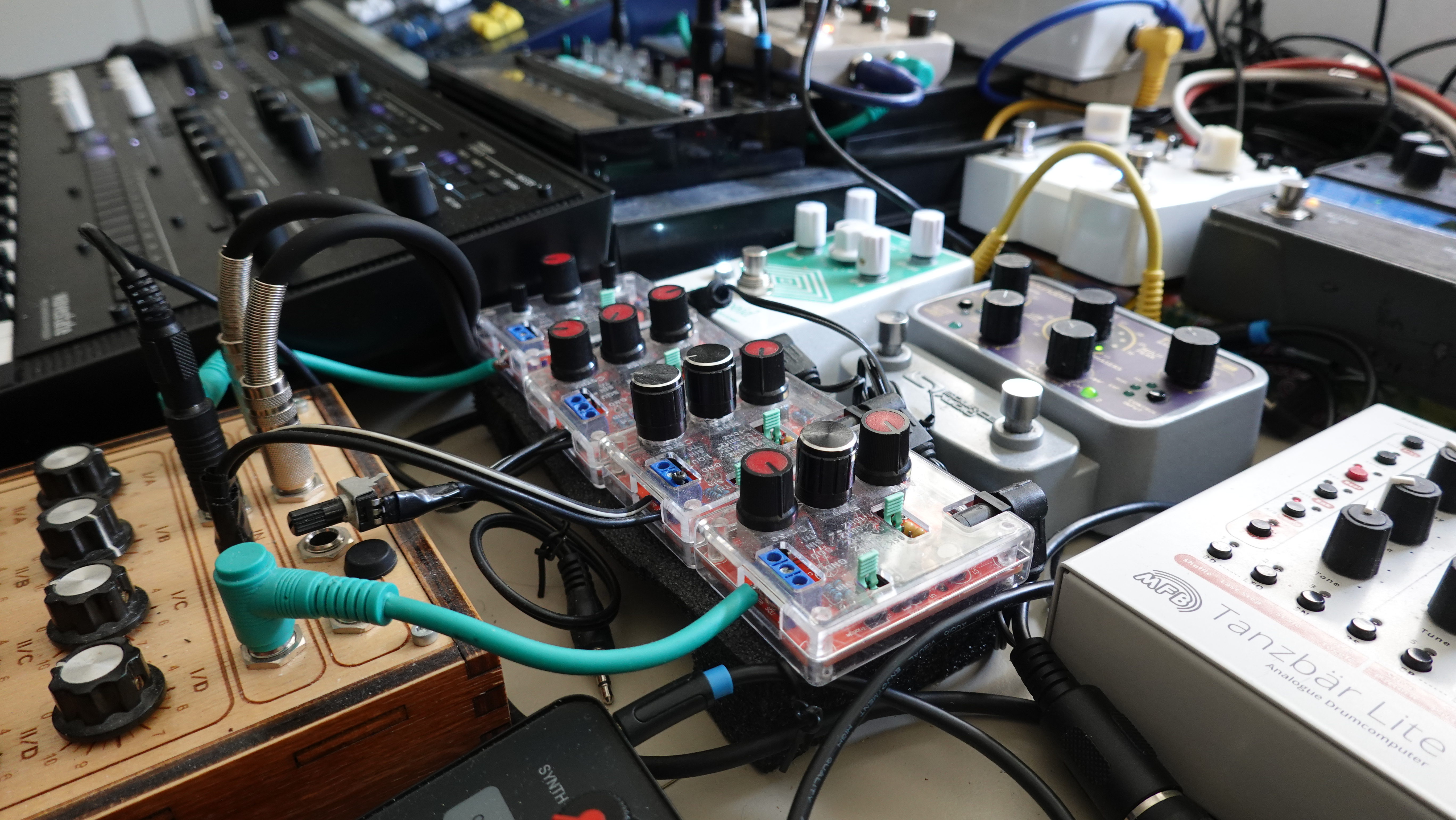
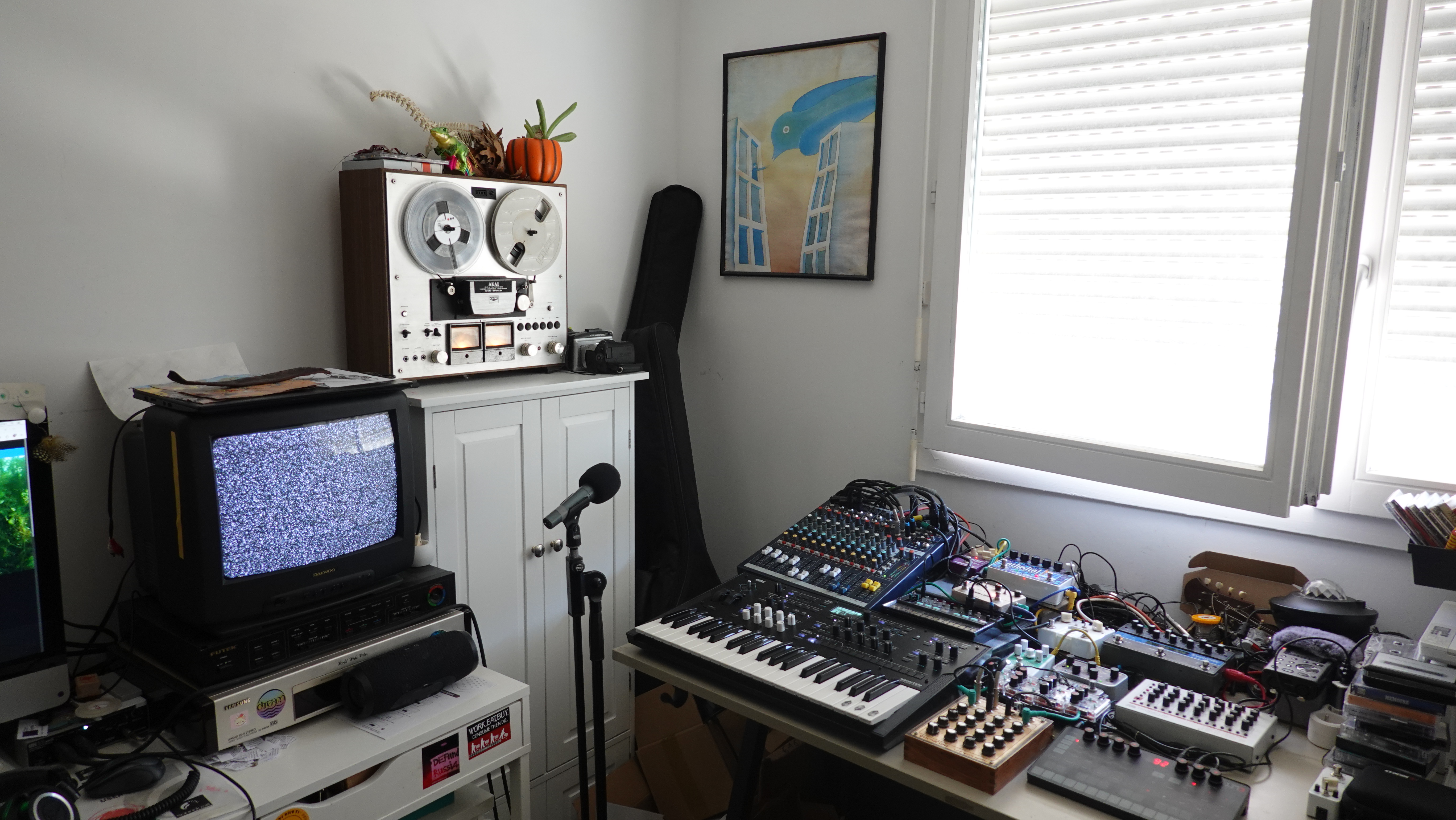
– I used to make all my music on a computer, and I did a lot of processing of all sorts of field recordings and found sounds, acoustic instruments — because the sound of most VST plugins didn’t suit me at all, and I used them little. About 7 years ago I started switching to “hardware” synths, and this, of course, is a completely different matter — the range of possibilities is immediately much wider. Despite the fact that there may be more restrictions. But probably that’s what stimulates imagination and ingenuity!
However, I have nothing against creating music on a computer — I’m sure there are many very good plugins and ways to work with them. It’s just that personally, I find it more comfortable to look at the screen less and turn the knobs more.
– Can you recommend any cool recordings to the readers and listeners of Dronarivm that you yourself have recently enjoyed?
– To be honest, lately I’ve mostly been listening to old tapes with music for meditation and relaxation — all sorts of new age that came out in the ’80s and ’90s, and which can still be found in abundance at flea markets. Some completely unremarkable releases from the past, about which you can often find no information. I don’t even know what exactly attracts me to this kind of music, but I’m really hooked on it 😁
Perhaps it’s precisely because of the process of searching for it — it’s always interesting to find something that isn’t even on Discogs, or that, even if it survived until the digital age, drowned in the streams of information.
For the second year now, I’ve been posting my finds on YouTube: https://www.youtube.com/@tape_stuff.
But there are also modern releases, so this is probably the best place to understand what is playing in my tape recorder (and I listen to music mainly this way).
In addition, I can recommend my friend Nyoka Shoje, with whom we recently participated in your compilation — his music will definitely appeal to lovers of soft, natural drone.
Well, in my mix I collected what is currently in rotation.
Discover more from DRONARIVM
Subscribe to get the latest posts sent to your email.
 DRONARIVM